
Send or receive money abroad? New tax rules will change your paperwork
New Delhi, Apr 3, 2026
If you send money abroad, receive payments from overseas, or have any international income, India’s new tax rules coming into force from April 1, 2026 could directly impact you—and in a big way.
The Central Board of Direct Taxes (‘CBDT’) has notified the Income-tax Rules, 2026 (‘Rules 2026’) along with the Forms, for the Income-tax Act, 2025, which has come into force on 1 April 2026.
The CBDT has also released Frequently Asked Questions (‘FAQs’) and Guidance Notes to help the taxpayers navigate the new forms. However, it is clarified that the FAQs and Guidance Notes are intended solely as educational resources—for any legal interpretation, the relevant provisions of the ITA 2025, and the Rules 2026 should be referred.
This Flash News captures some of the key changes introduced in the Rules 2026 and the forms relating to reporting compliances for claiming tax treaty benefits, foreign remittances, and claiming foreign tax credit, as compared to the Income-tax Rules, 1962 and the related forms.
The updated rules under the Income-tax Act, 2025 significantly tighten reporting requirements for foreign transactions, making compliance more detailed, structured and harder to ignore.
So, what’s changing?
At the core, the government is saying: If money is moving across borders, we want clearer, more detailed reporting.
Here are the key changes explained simply:
1. Sending money abroad? Reporting gets stricter
If you make a payment to a non-resident (for example, for services, investments, or business):
• You must now report the transaction in a new Form 145
• The form requires much more detailed classification of the payment
• You’ll have to choose from 65 specific categories (like software purchase, consulting fees, etc.)
Earlier, reporting was broader. Now, it’s more precise and trackable.
2. Big remittances need CA certification
If your foreign remittance exceeds: ₹5 lakh in a year
You must:
• Get a certificate from a Chartered Accountant (Form 146)
• Submit it along with your reporting
This adds an extra compliance step, especially for:
• Freelancers working with foreign clients
• Business owners paying overseas vendors
• Individuals making large foreign investments
3. Claiming tax treaty benefits? More paperwork
If you’re a non-resident or dealing with one and want to claim tax treaty benefits (to avoid double taxation):
Earlier:
A Tax Residency Certificate (TRC) was often enough
Now:
You must mandatorily file a new Form 41, even if you already have a TRC
Additional details required include:
• Contact details
• Indian address (if available)
• A formal declaration confirming no information is hidden
In short: claiming treaty benefits is now more documentation-heavy
4. No PAN? Still possible—but with conditions
The rules allow some flexibility:
• A non-resident may submit forms without a PAN in certain cases
• But only if they are not required to have one
This helps ease compliance for foreign individuals—but doesn’t reduce reporting obligations
5. More checks on global income and tax credits
If you:
• Earn income abroad
• Or claim foreign tax credit
There are tighter requirements:
• You may need certification from a Chartered Accountant for higher claims
• Reporting formats are more structured and standardised
Why is the government doing this?
This isn’t random—it’s part of a bigger shift.
India is moving towards:
• Stronger tracking of cross-border money flows
• Data-driven tax enforcement
• Alignment with global information-sharing systems
Recent policy signals show that foreign income and assets are now a key compliance focus, with technology making it easier for authorities to detect mismatches.
"The new rules have an increased focus on uniformity, transparency and data consistency. While many changes are structural in nature such as the alignment of terminology, non-resident taxpayers are likely to face higher compliance burden, especially in relation to tax treaty claims, foreign remittances and foreign tax credit," said KPMG in a report.
Key Changes in International Tax Reporting Rules (From April 2026)
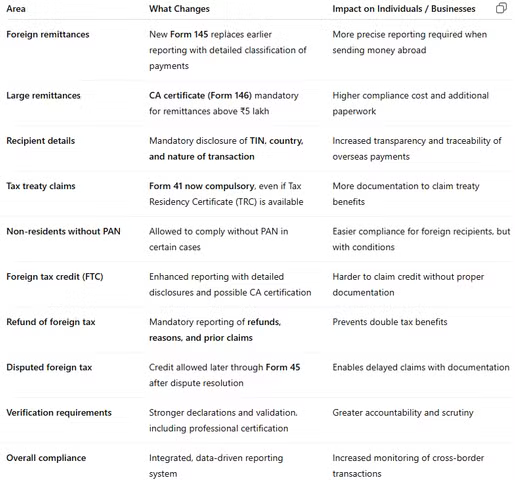
Quick takeaway
• More forms → Form 145, 146, 41, 44, 45
• More details → exact nature of payments, foreign IDs, purpose
• More verification → Chartered Accountant involvement
• More scrutiny → system-driven tracking of global money
[The Business Standard]